Fire Door Retention –
Commercial fire safety systems across Bradford are becoming increasingly integrated, with businesses now recognising that effective fire protection relies on multiple systems working together rather than operating independently.
One area often overlooked within commercial premises is the relationship between:
- fire doors
- fire door retention systems
- evacuation routes
- and fire extinguisher positioning.
As modern buildings become more operationally complex, properly coordinated fire safety planning is becoming increasingly important.
What Is A Fire Door Retention System?
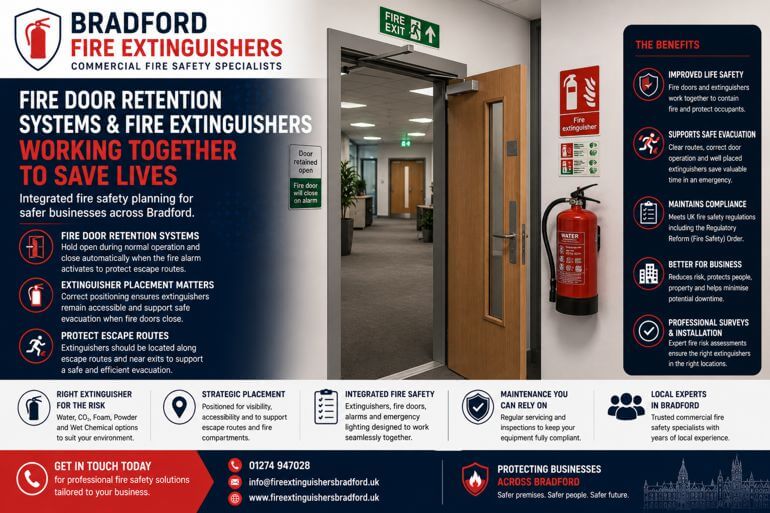
Fire door retention systems allow designated fire doors to remain open during normal building operation while automatically closing when the fire alarm system activates.
These systems are commonly used within:
- offices
- schools
- healthcare facilities
- apartment blocks
- and commercial premises
where permanently closed fire doors may create:
- accessibility problems
- operational inconvenience
- or restricted movement.
Open Fire Doors Improve Daily Building Operation
Many commercial environments rely on smooth internal movement between:
- corridors
- departments
- reception areas
- and escape routes.
Retained-open fire doors can improve:
- accessibility
- workflow
- ventilation
- and general building usability
without compromising fire compartmentation during alarm conditions.
Fire Doors And Extinguisher Placement Must Be Coordinated
Fire extinguisher positioning should always consider:
- escape route direction
- fire compartment layouts
- and door closing behaviour
Poor extinguisher placement may create problems where:
- access becomes restricted
- escape routes narrow
- or closing doors obstruct extinguisher retrieval.
Extinguishers Should Support Safe Escape
Commercial extinguishers are primarily intended to support:
- safe evacuation
- small fire suppression
- and escape route protection
rather than prolonged firefighting.
Correct placement near:
- exits
- fire points
- and protected circulation areas
remains critically important.
Fire Door Closure Can Affect Escape Routes
When alarm systems activate, retained doors automatically close to:
- slow smoke spread
- protect compartments
- and maintain protected escape routes.
Businesses should ensure extinguisher locations remain:
- clearly accessible
- visible
- and safely reachable
after door closure occurs.
Modern Commercial Buildings Often Require More Complex Planning
Larger premises such as:
- office blocks
- schools
- warehouses
- healthcare sites
- and mixed-use buildings
may contain:
- multiple compartments
- phased evacuation arrangements
- and complex internal circulation routes.
Integrated fire safety planning becomes increasingly important in these environments.
Different Extinguisher Types Must Match The Risk
Commercial buildings commonly require combinations of:
- water extinguishers
- CO2 extinguishers
- foam extinguishers
- powder extinguishers
- and wet chemical extinguishers
depending on:
- electrical risks
- cooking risks
- combustible materials
- and operational activities.
Professional Surveys Help Improve Compliance
Professional fire risk assessment and extinguisher surveys help ensure:
- correct extinguisher selection
- suitable mounting positions
- compliant signage
- and safe fire point layouts
throughout the building.
Modern Fire Safety Is Becoming More Integrated
Commercial fire protection increasingly focuses on:
- integrated life safety systems
- coordinated evacuation strategies
- and compartmentation planning
rather than isolated individual components.
Businesses increasingly expect:
- alarms
- fire doors
- extinguishers
- emergency lighting
- and evacuation systems
to operate together effectively.
Smarter Building Fire Protection Requires Joined-Up Planning
For businesses in Bradford, professionally designed fire extinguisher layouts that consider fire door retention systems help provide:
- safer evacuation support
- clearer escape routes
- improved operational practicality
- and stronger overall fire protection compliance
As commercial fire safety standards continue evolving, integrated fire protection planning is becoming increasingly important within modern business premises.
Frequently Asked Questions
What is a fire door retention system?
It allows fire doors to remain open normally while automatically closing during a fire alarm activation.
Why does extinguisher positioning matter near fire doors?
Poor placement may restrict access or create issues once fire doors close during an emergency.
Should fire extinguishers be positioned near exits?
Yes. Extinguishers are commonly positioned to support safe evacuation and escape route protection.