Bradford Fire Extinguishers Commercial –
For businesses in Bradford, fire extinguishers are often treated as a compliance requirement — something that needs to be installed, signed off and maintained. In reality, their effectiveness depends entirely on how well they match the specific risks within the premises. Choosing the wrong type, or placing them incorrectly, can render them ineffective at the point they are needed most.
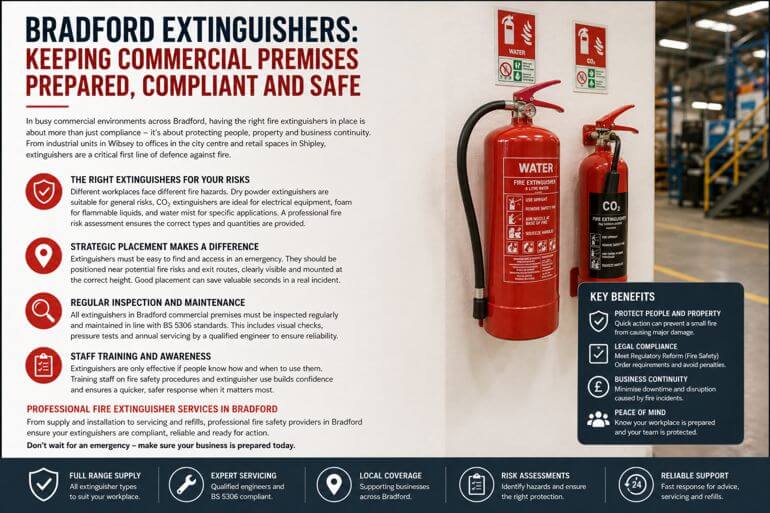
Different commercial environments present very different fire risks. Offices, warehouses, kitchens and industrial units all require tailored fire protection. A generic approach to extinguisher provision is one of the most common weaknesses seen in Bradford workplaces.
Water extinguishers are typically used for Class A fires involving combustible materials such as paper, wood and textiles. These are common in office environments, making water extinguishers a standard choice in many commercial buildings. However, they are not suitable for electrical fires or flammable liquids, which are often present in other types of premises.
CO2 extinguishers are designed for electrical risks. In environments with IT equipment, server rooms or machinery, CO2 units are essential. They extinguish fire without leaving residue, which is particularly important where sensitive equipment is involved.
Foam extinguishers provide a more versatile option, particularly where both solid materials and flammable liquids are present. In retail or mixed-use environments in Bradford, foam units are often used to provide broader coverage.
Dry powder extinguishers are sometimes used in higher-risk environments, particularly where multiple fire classes may be present. However, their use in enclosed spaces is often limited due to visibility and clean-up considerations, meaning they must be specified carefully.
The key point is that extinguisher selection must be based on a proper fire risk assessment. This ensures that each area of the premises is equipped with the correct type of extinguisher for the hazards present.
Placement is equally important. Extinguishers must be positioned where they are easily accessible and clearly visible, particularly near exit routes and high-risk areas. In an emergency, delays caused by poor placement can have serious consequences.
In Bradford commercial premises, this often means ensuring that extinguishers are distributed logically throughout the building rather than clustered in one location. Each unit should be available at the point of risk, not just installed to meet minimum requirements.
Signage supports this by ensuring that extinguishers can be located quickly. Clear, compliant signage helps guide users in an emergency, particularly in larger or more complex buildings.
Maintenance is a critical part of ensuring that extinguishers remain effective. Regular servicing in line with relevant standards ensures that each unit is fully operational. This includes checking pressure levels, seals and overall condition.
Visual inspections should also be carried out more frequently to ensure that extinguishers remain in place, unobstructed and ready for use. In busy Bradford workplaces, it is not uncommon for units to be moved, blocked or overlooked without regular checks.
Training is often overlooked but is essential. Having the correct extinguishers in place is only effective if staff understand when and how to use them safely. Basic fire safety training ensures that employees can respond appropriately without putting themselves at risk.
Fire extinguishers should always be seen as a first response measure, intended to control small fires in their early stages. They are not a substitute for evacuation procedures or wider fire safety planning.
Documentation is also important. Businesses must be able to demonstrate that extinguishers are correctly specified, installed and maintained. This supports compliance and ensures that systems stand up to inspection.
For businesses in Bradford, effective fire extinguisher provision is about more than ticking a box. By matching extinguisher types to real workplace risks, ensuring correct placement and maintaining systems properly, businesses can create a far more effective first line of defence against fire.