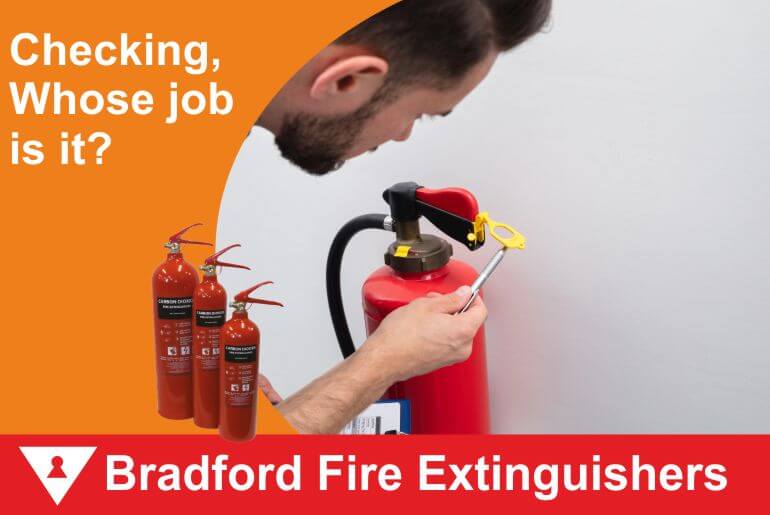
Who Is Responsible for Checking Fire Extinguishers in a Workplace?
Fire extinguishers are a familiar sight in commercial premises, but responsibility for checking them is sometimes less clear. Is it the business owner, facilities manager, landlord, employee or external fire extinguisher engineer?
The answer depends partly on the type of check being carried out.
For businesses in Bradford, understanding the distinction between routine workplace checks and professional fire extinguisher servicing can help prevent equipment being overlooked and provide a clearer approach to fire safety management.
The Responsible Person Has Overall Responsibility
Under fire safety legislation, responsibility ultimately rests with the person or people responsible for fire safety within the premises.
Depending on the organisation, this could include an employer, business owner, building occupier or somebody with control over the premises.
Larger organisations will often delegate day-to-day fire safety tasks to a facilities manager, health and safety manager or another nominated employee.
Delegating those duties does not mean extinguishers can simply be installed and forgotten. Procedures should be established to ensure equipment is routinely checked and professionally maintained.
What Should Businesses Check Themselves?
Businesses should undertake regular visual checks of their extinguishers between professional service visits.
These are relatively straightforward inspections and do not involve dismantling or technically servicing the equipment.
Checks should identify obvious problems such as:
- An extinguisher missing from its designated position
- Equipment being obstructed by stock or furniture
- Visible physical damage
- Missing or damaged safety pins or tamper indicators
- An abnormal pressure gauge reading where a gauge is fitted
- Missing or obscured identification signage
- Operating instructions becoming illegible
A designated member of staff can normally undertake these routine checks provided they understand what they are looking for and know how to report a problem.
Keeping a record of checks can also help demonstrate that extinguisher provision is being actively managed.
Who Carries Out Annual Fire Extinguisher Servicing?
Routine workplace checks are not a substitute for professional maintenance.
Fire extinguishers should be serviced by a competent person in accordance with the appropriate servicing schedule and relevant British Standards.
A trained extinguisher engineer carries out considerably more detailed checks than would be expected during a routine workplace inspection.
Depending on the equipment and service required, this can include examining its condition, components, pressure, weight, maintenance history and overall suitability for continued service.
Any defects or required remedial work can then be identified.
What About Landlords and Tenants?
Responsibility can become more complicated in rented commercial premises.
A landlord may maintain equipment within communal areas while individual tenants have responsibility for extinguishers inside their own units.
However, arrangements differ between properties.
Businesses should not assume the landlord is automatically responsible for every extinguisher simply because the premises are leased.
Lease agreements and fire safety arrangements should make responsibilities clear. Where different parties share responsibility, communication is particularly important to prevent equipment falling between two maintenance programmes.
What Happens When an Extinguisher Is Damaged?
Businesses should not wait until the next scheduled service if an extinguisher appears damaged, has been discharged or may have been tampered with.
The issue should be reported and assessed promptly.
The same applies if an extinguisher disappears during a building alteration, is moved to another department or becomes inaccessible because of new storage arrangements.
Routine checks are valuable precisely because they can identify these problems between professional servicing visits.
Responsibility Should Be Clearly Documented
A simple internal procedure can remove much of the uncertainty surrounding extinguisher management.
Businesses can specify:
- Who carries out routine checks
- How frequently checks are recorded
- Who receives reports of defects
- Who arranges professional servicing
- Where service documentation is retained
- Who reviews provision following workplace changes
For larger Bradford businesses with several departments, buildings or sites, clearly allocating these responsibilities becomes particularly important.
Professional Servicing and Workplace Checks Work Together
Effective extinguisher management is not a choice between internal inspections and professional servicing.
Businesses need both.
Routine workplace checks identify obvious problems as they develop, while professional servicing provides the technical inspection and maintenance required to keep extinguishers serviceable.
Together, they create a much stronger approach than simply waiting for an engineer to visit once a year.
Fire Extinguishers Bradford
Fire Extinguishers Bradford supplies, installs and services portable fire extinguishers for commercial premises throughout Bradford and the surrounding area.
We work with businesses, facilities managers and responsible persons to help ensure extinguisher provision is appropriate, properly maintained and supported by professional servicing.
For advice about commercial fire extinguisher servicing or new equipment, contact Fire Extinguishers Bradford.
Tel: 01274 947028
Email: info@fireextinguishersbradford.uk
Website: fireextinguishersbradford.uk